


Multimodal AI · VR/AR · Interaction
The Future of Multimodal AI: Redefining Human–Technology Interaction
Why multimodal AI now
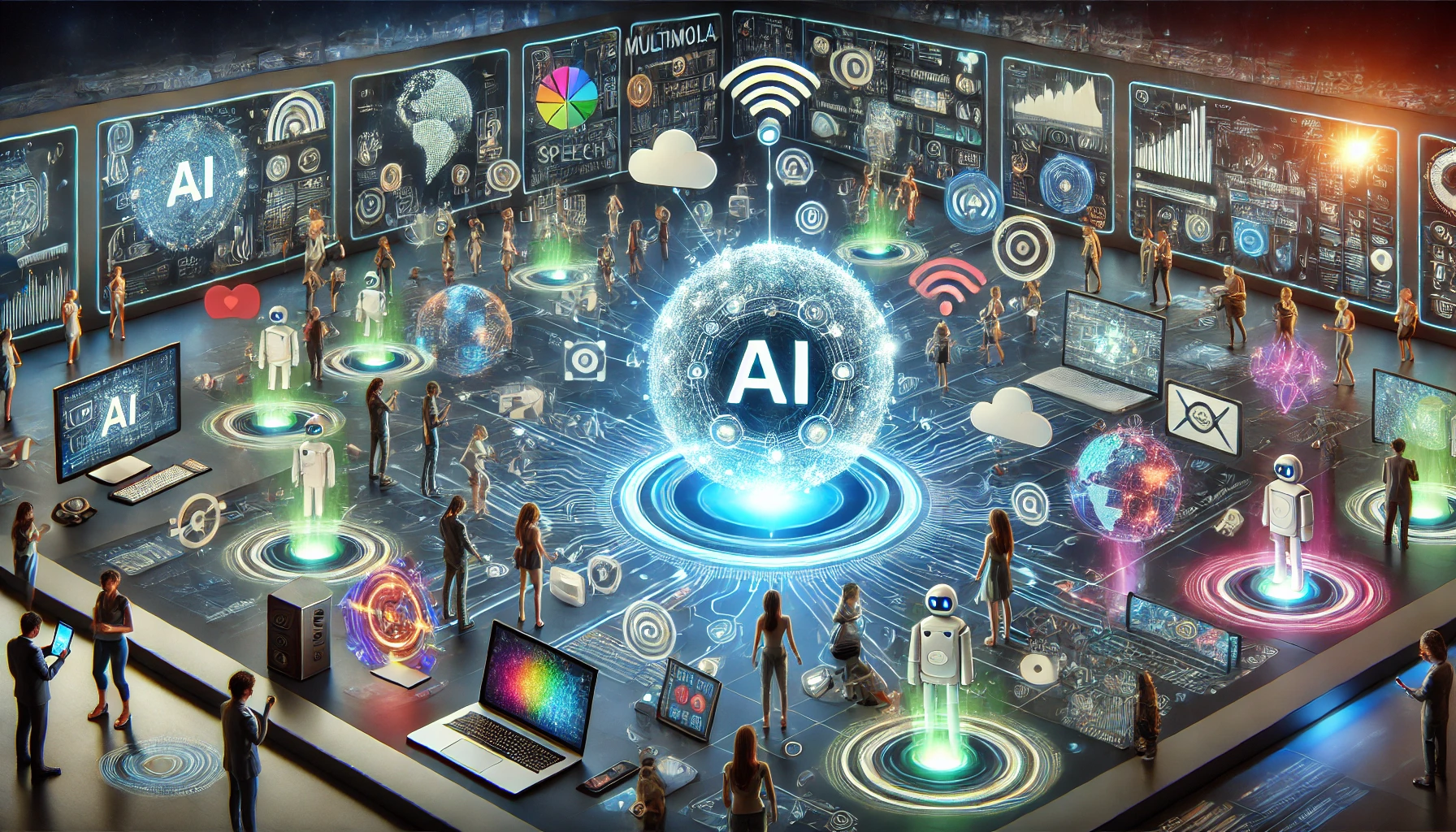
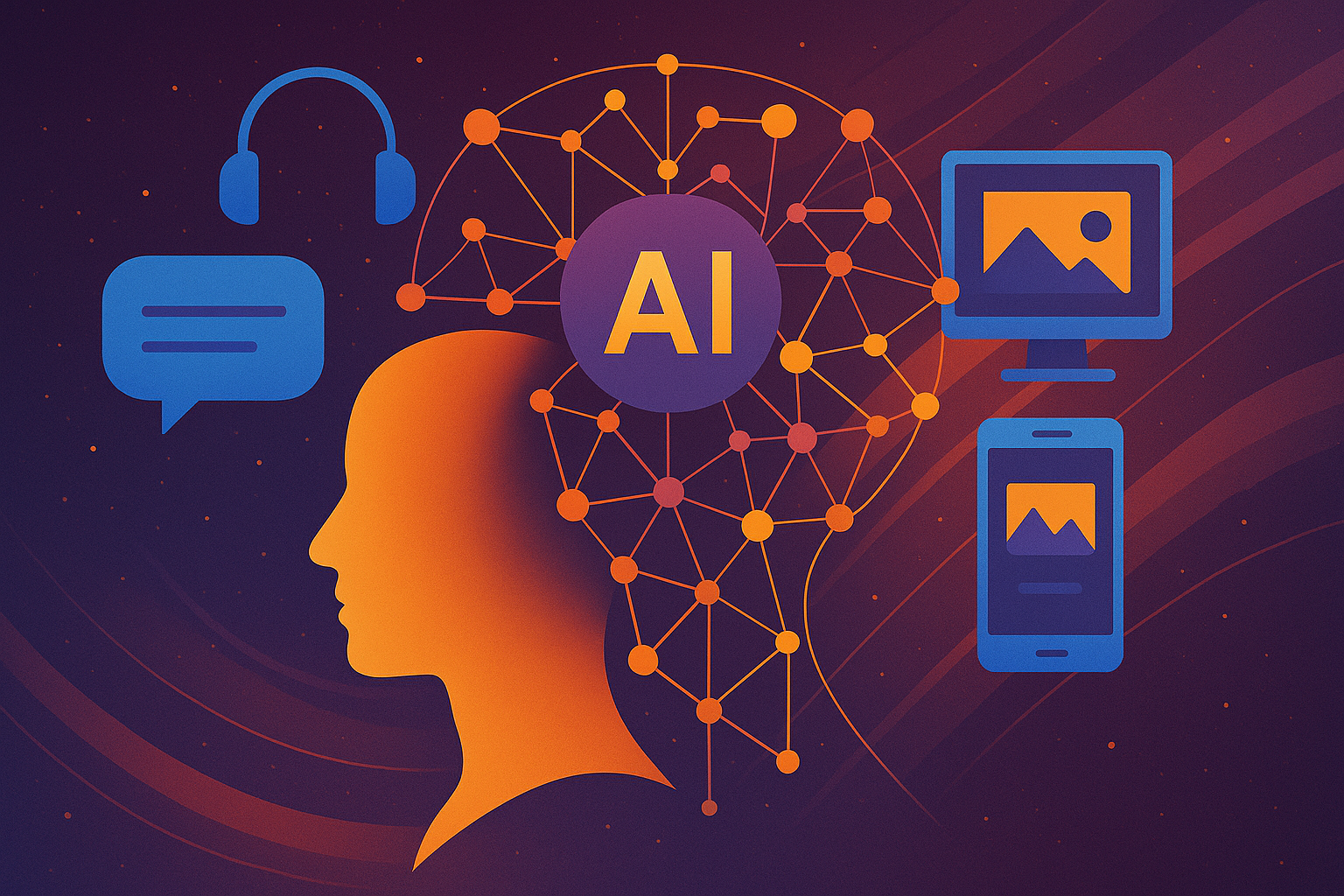
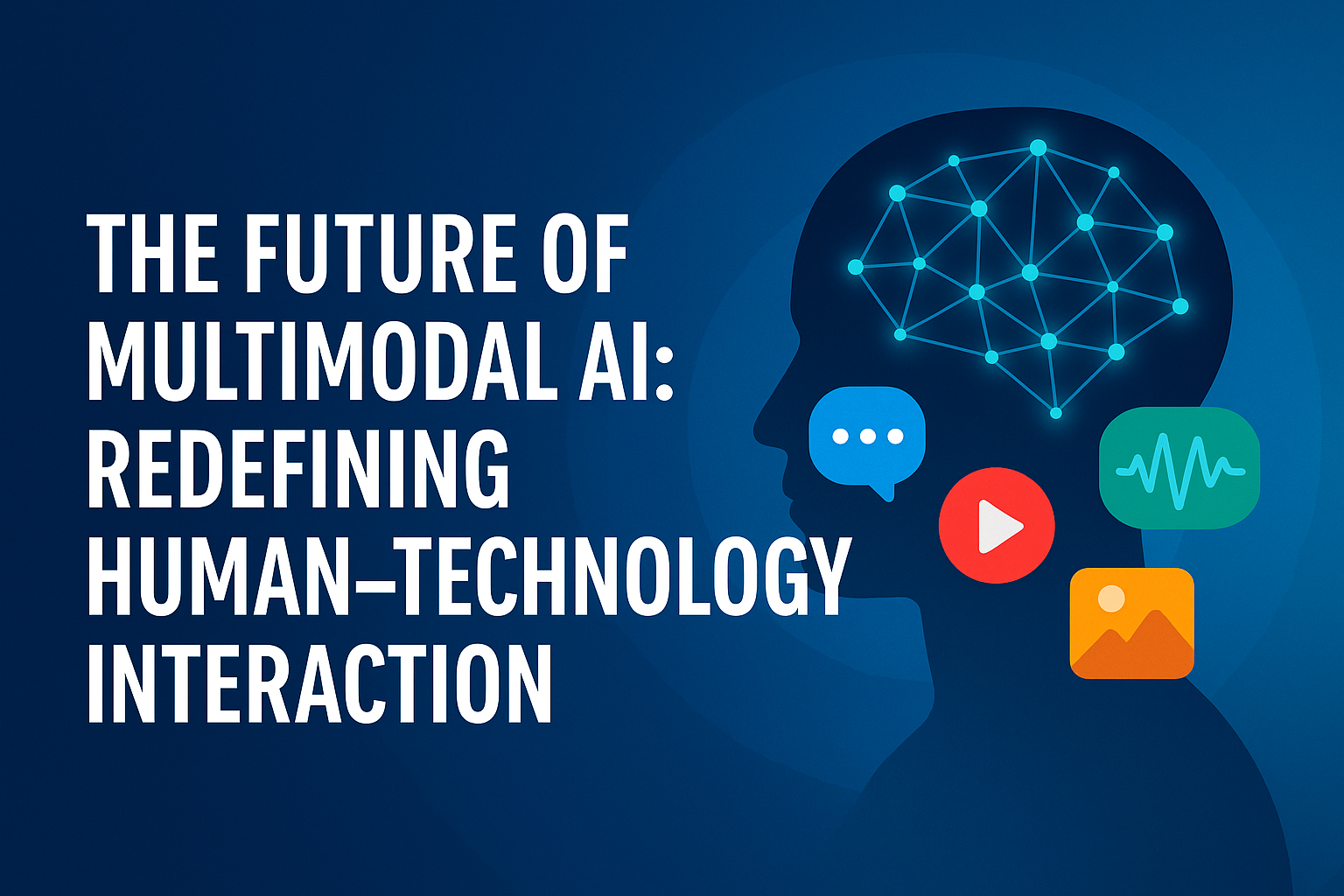
Humans interpret the world through many signals at once—sight, sound, language, motion, spatial context. Multimodal AI mirrors this capability by fusing text, images, audio, video, and sensor data into a single reasoning space. The result is interaction that feels less like “using software” and more like communicating with a collaborative partner.
For a strategic overview, see: Unlocking the Future of Multimodal AI, Integrating Diverse Data for Engagement, and The Rise of Multimodal AI.
How multimodal models work
Encoders, decoders, and shared embedding spaces
Modern systems typically pair modality‑specific encoders (e.g., a vision transformer for images, a speech model for audio) with a shared latent space where different signals are aligned. Contrastive pretraining popularized by CLIP aligns text and image representations so that “a dog on a skateboard” sits close to images of that concept. Once aligned, a decoder (often a large language model) can reason over fused context and produce outputs in natural language or other modalities.
Fusion strategies
Early fusion merges modalities at the input stage; late fusion combines independent predictions; hybrid fusion mixes both, allowing fine‑grained cross‑modal attention. Retrieval‑augmented designs fetch relevant frames, regions, audio spans, or documents to ground responses in evidence.
Instruction tuning and tool use
After pretraining, instruction tuning teaches models to follow human prompts and chain tools (vision, OCR, speech‑to‑text, web search) for complex tasks. The most capable systems route subtasks to specialized components and stitch the results into a coherent answer in near real time.
Latency and scaling
Two practical constraints dominate deployment: latency and cost. Token‑efficient prompting, compressed vision features, on‑device preprocessing, and batching on the server side keep experiences responsive while controlling inference spend.
High‑impact applications
Entertainment and interactive media
Branching narratives, performance capture, and emotion‑aware NPCs turn audiences into participants. Multimodal systems track voice, gaze, gesture, and affect to adapt scene pacing, difficulty, and dialogue.
Education
AI tutors combine diagrams, spoken explanations, and worked examples. They can diagnose misconceptions from handwriting, eye movements, or speech patterns and adjust instruction style accordingly.
Healthcare
From clinical note generation that fuses speech and EHR context to triage assistants that read images, waveforms, and labs, multimodal pipelines can raise quality and reduce provider burnout when paired with rigorous oversight.
Customer experience
Contact centers gain agents that “see” screenshots, “hear” tone, and “read” logs to resolve issues faster. In retail, AR try‑ons and visual search align user intent with inventory in seconds.
Robotics and industrial
Robots benefit from grounding language in perception: “pick the red bolt left of the motor.” Combining force sensors, vision, and language narrows the gap between instruction and execution.
Designing for real‑time interaction
Inputs
- Vision: images, video frames, depth, segmentation masks.
- Audio: speech, prosody, ambient cues.
- Language: prompts, instructions, transcripts.
- Sensors: IMU, LiDAR, clickstreams, biometrics (where appropriate).
System patterns
- Edge preprocessing for compression, redaction, and privacy.
- Streaming I/O to start responding before all tokens arrive.
- Fallback modes when a modality is missing or degraded.
- Human‑in‑the‑loop review for sensitive actions.
Ethics, safety, and governance
Bias and representation
Vision and speech datasets can underrepresent accents, skin tones, and contexts. Regular audits, rebalancing, and counterfactual evaluation reduce disparate error rates. Report failure modes and allow user appeals.
Consent and privacy
Collect only what’s needed; prefer on‑device processing and ephemeral storage. Provide clear notices for camera/mic use and offer non‑visual alternatives for accessibility.
Safety rails
Layer content filters, harmful‑action blocks, and contextual risk scoring. For consequential use (health, finance, autonomy) require human oversight, robust logging, and incident response plans.
Industry impact and jobs
Multimodal AI shifts roles from manual production to orchestration: designing prompts, datasets, guardrails, and evaluation. Creative fields see productivity gains in pre‑viz, localization, and accessible design; net impact depends on re‑skilling and distribution of the gains.
Measuring success
- Quality: task accuracy, consistency across modalities, factual grounding.
- Experience: time‑to‑first‑token, latency p95/p99, session completion rates.
- Safety: toxic content rate, false accept/deny, privacy incidents.
- Cost: inference per session, edge vs. cloud split.
Roadmap: next 24 months
- On‑device multimodal for private perception and lower latency.
- Structured tool use: charts, tables, code, and actions from mixed inputs.
- Better memory with user‑controlled profiles and consent.
- Evaluation standards for safety and cross‑modal reliability.
For deeper context, revisit: Unlocking the Future · Integrating Diverse Data · The Rise of Multimodal AI.
FAQ
How is multimodal AI different from unimodal AI?
Unimodal models process a single input type. Multimodal systems align several inputs—language, vision, audio, and sensors—into a shared space so the model can reason across them.
What’s the biggest technical bottleneck?
End-to-end latency. The fix blends edge preprocessing, compressed representations, selective retrieval, and streaming output to keep experiences responsive.
How do we deploy responsibly?
Practice data minimization, transparent consent, opt-outs, audit trails, red-teaming, and human oversight for high-risk decisions. Log and review failures, and publish model cards.