

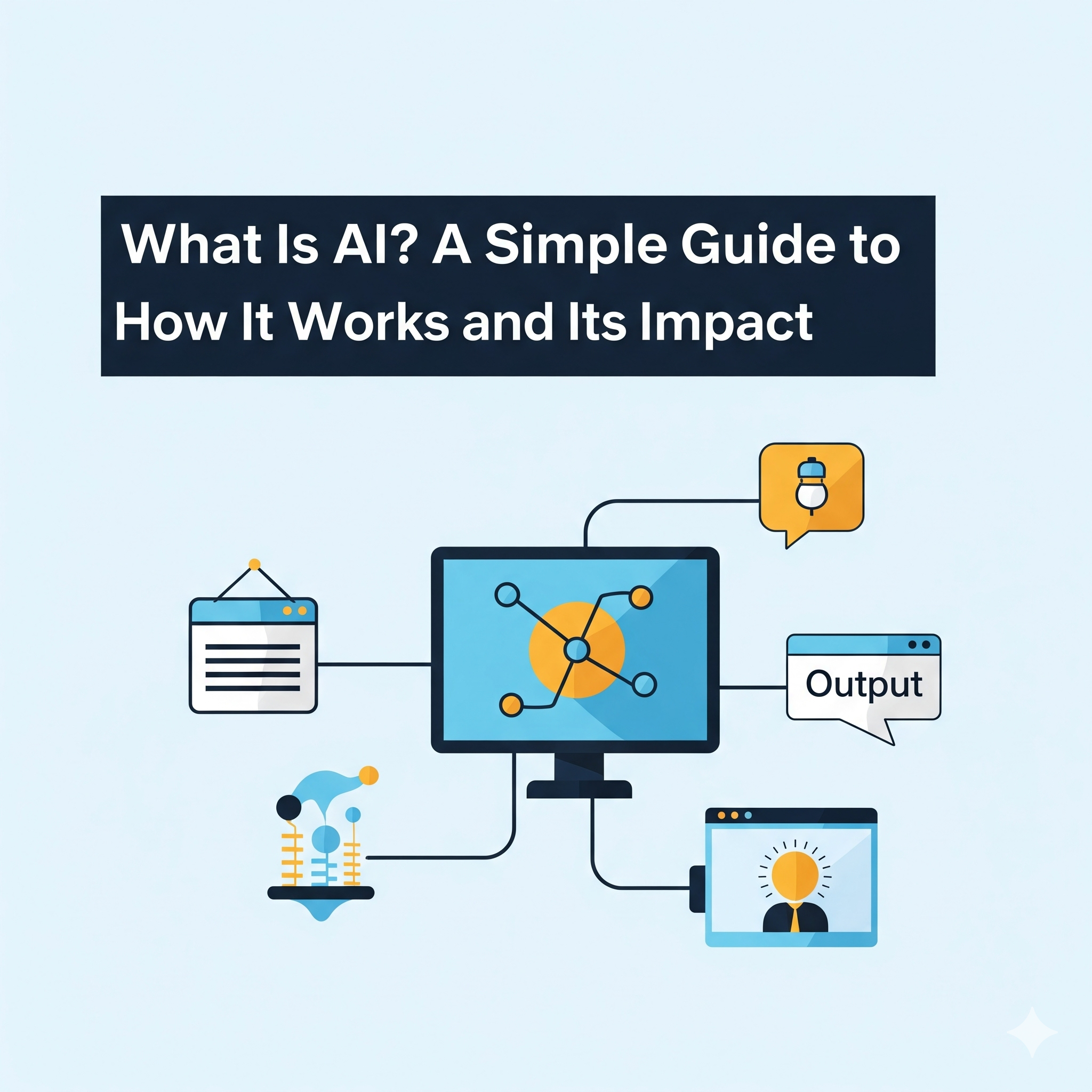
What Is AI? A Simple Guide to How It Works and Its Impact
You hear about Artificial Intelligence (AI) everywhere—from your smartphone to the latest news. But what exactly is it? Simply put, AI is technology that allows computers to think, learn, and solve problems like humans do.
This guide will break down the key parts of AI in simple terms, show you how it’s already a part of your life, and look at the big questions about its future.
What is Machine Learning? The Brains Behind AI
The main engine that powers most modern AI is machine learning.
Imagine you’re teaching a child to recognize a dog. You wouldn’t write a list of rules like “has pointy ears, has whiskers, has a tail.” Instead, you’d show them lots of pictures of cats. Eventually, they learn to spot a cat on their own.
Machine learning works the same way. Instead of being programmed with strict rules, a computer is fed huge amounts of data (like pictures, numbers, or text). It learns to find patterns in that data and then uses those patterns to make decisions or predictions on its own.
Here are a few real-world examples:
- Shopping: When sites like Amazon or Netflix recommend a product or a movie you might like, that’s machine learning at work. It has learned your preferences based on what you’ve bought or watched before.
The more data these systems see, the smarter and more accurate they get.
What is Natural Language Processing (NLP)? Teaching Computers Our Language 🗣️
Natural Language Processing (NLP) is a type of AI that helps computers understand, interpret, and respond to human language. It’s the magic that bridges the gap between how we talk and how computers “think.”
You probably use NLP every day without even realizing it.
- Voice Assistants: When you ask Siri or Alexa a question, NLP allows the device to understand what you said and find the answer.
- Chatbots: Many websites have customer service chatbots that can answer your questions instantly. These bots use NLP to figure out your problem and provide help.
- Translation Tools: Services like Google Translate use advanced NLP to translate words and even entire sentences between different languages in real-time, breaking down communication barriers across the globe.
As NLP gets better, talking to a computer will feel more and more like talking to another person.
The Big Questions: AI’s Impact on Society
AI is an amazing tool, but it also comes with important challenges and questions we need to think about.
Privacy Concerns
AI systems often need a lot of data to learn, which can include personal information. Technologies like facial recognition are useful for security, but they also raise serious questions about our right to privacy. Finding the right balance between using data for good and protecting people’s information is a major challenge.
AI and Your Job
Many people worry that AI-powered robots and automation will take away jobs. It’s true that some jobs with repetitive tasks may be replaced. However, AI is also creating brand new jobs in areas like data science, AI development, and ethics. The key will be to help workers learn new skills for the jobs of the future.
The Problem of Bias
An AI is only as good as the data it’s trained on. If the data used to train an AI system contains human biases (like unfair preferences based on gender or race), the AI will learn and repeat those biases. For example, a hiring AI trained on biased data might unfairly favor male applicants. Making sure AI is fair and unbiased is one of the most important goals for developers today.
What’s Next for AI?
Artificial Intelligence is no longer just science fiction; it’s a powerful tool that’s already reshaping our world. From the machine learning that powers our favorite apps to the NLP that lets us talk to our devices, AI is everywhere.
The future of AI is incredibly exciting, promising new inventions that could solve some of the world’s biggest problems. However, it’s crucial that we develop this technology responsibly. By focusing on ethics and fairness, we can make sure AI helps create a better and more equal future for everyone.
Frequently Asked Questions (FAQ)
1. What is the difference between AI and machine learning? AI is the broad idea of making machines smart. Machine learning is a specific method for achieving AI, where computers learn from data without being explicitly programmed for every task.
2. Will AI take all our jobs? It’s unlikely to take all jobs. While AI will automate some tasks, it will also create new jobs that require human skills like creativity, critical thinking, and emotional intelligence.
3. Is AI dangerous? Like any powerful technology, AI has the potential for misuse. The biggest risks today are things like algorithmic bias, privacy invasion, and job displacement. That’s why having discussions about AI ethics and safety is so important.